August 17, 2026
IP KVM eMMC Quality and SD Card Provenance: Who Ships Genuine Storage
Storage is the part most likely to fail on an always-on device. We read the part number off every one.
By Andrew Douglass · Founder
Disclosure: Our articles contain affiliate links, including Amazon. If you buy through one, we may earn a commission at no extra cost to you, and as an Amazon Associate we earn from qualifying purchases. It never affects our testing, measurements, or verdicts. Full disclosure.
An IP KVM is a small appliance that controls a computer remotely at the hardware level, and it boots from its own onboard flash: either a soldered eMMC chip or a removable microSD card. IP KVM eMMC quality is whether that storage is a genuine, reputable part or a cheap generic one, a choice that largely decides how long the device survives running around the clock.
Storage is the part of an always-on device most likely to fail. Flash wears out, and cheap flash wears out sooner, so this matters more than any spec sheet admits, and no vendor prints the part number on the box. We opened every IP KVM we own and read the storage part number off the board, then decoded it. The results split cleanly into three groups: genuine current parts, tier-2 or generic parts, and one device shipping a chip made in 2018.
The provenance table
Every entry is from a first-hand teardown, reading the printed part number and confirming it against the storage device's own registers. This covers the popular single-port devices: JetKVM, PiKVM, the Sipeed NanoKVMs, the GL.iNet Comets, TinyPilot, Luckfox, and BliKVM.
| Device | Storage | Part number | Provenance |
|---|---|---|---|
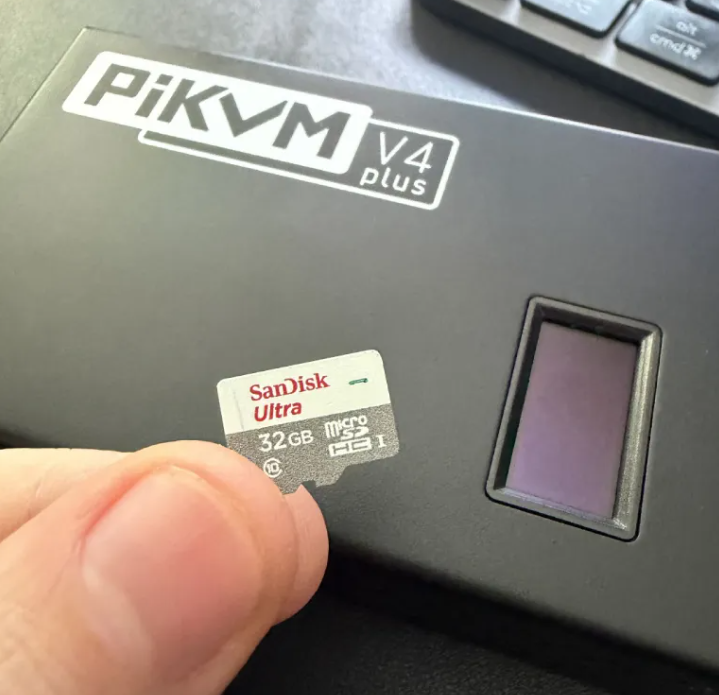
| PiKVM V4 Plus | Removable microSD | SanDisk SL32G (11/2024) | Genuine SanDisk |
| JetKVM | Removable microSD | JetKVM-labeled SanDisk | Genuine (rebadged SanDisk) |
| GL.iNet Comet | Soldered eMMC, 8 GB | Kioxia THGBMUG6C1LBAIL | Genuine Kioxia |
| TinyPilot Voyager 3 | Soldered eMMC, 32 GB | Samsung BJTD4R (08/2024) | Genuine Samsung |
| GL.iNet Comet Pro | Soldered eMMC | TWSC TEMCG101T30 | Tier-2 vendor |
| Sipeed NanoKVM Pro | Soldered eMMC, 64 GB | EMMC064G-YCW6T | Tier-2 vendor |
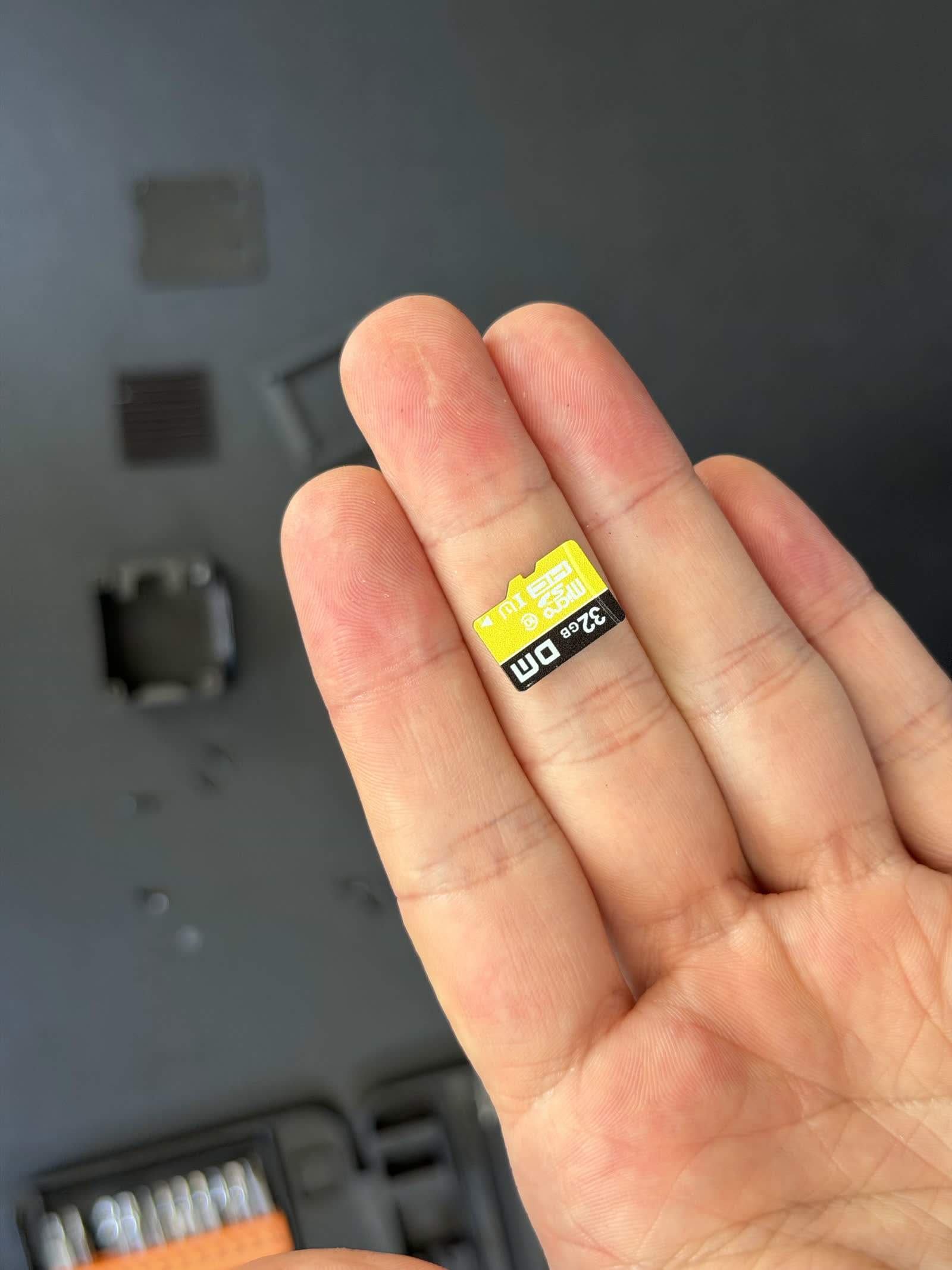
| Sipeed NanoKVM Full | Removable microSD | Generic "DM" 32 GB | Generic, no-name |
| Sipeed NanoKVM PCIe | Removable microSD | Sipeed-labeled generic | Generic, no-name |
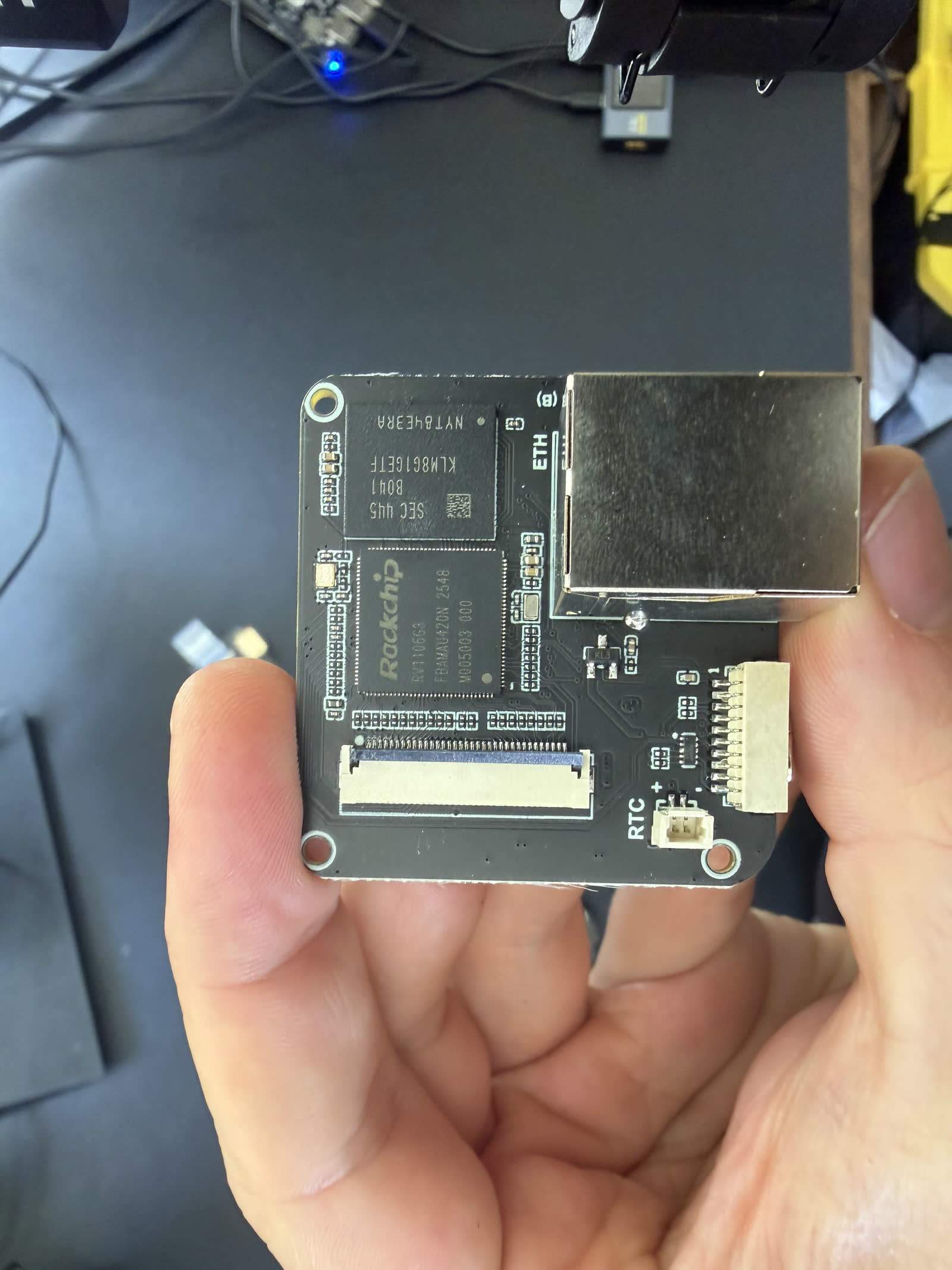
| Luckfox Pico KVM | Soldered eMMC, 8 GB | Samsung KLM8G1GETF (2018) | Genuine but old stock |
| BliKVM | Removable microSD | Unverified (our own card) | Unknown |
The genuine tier
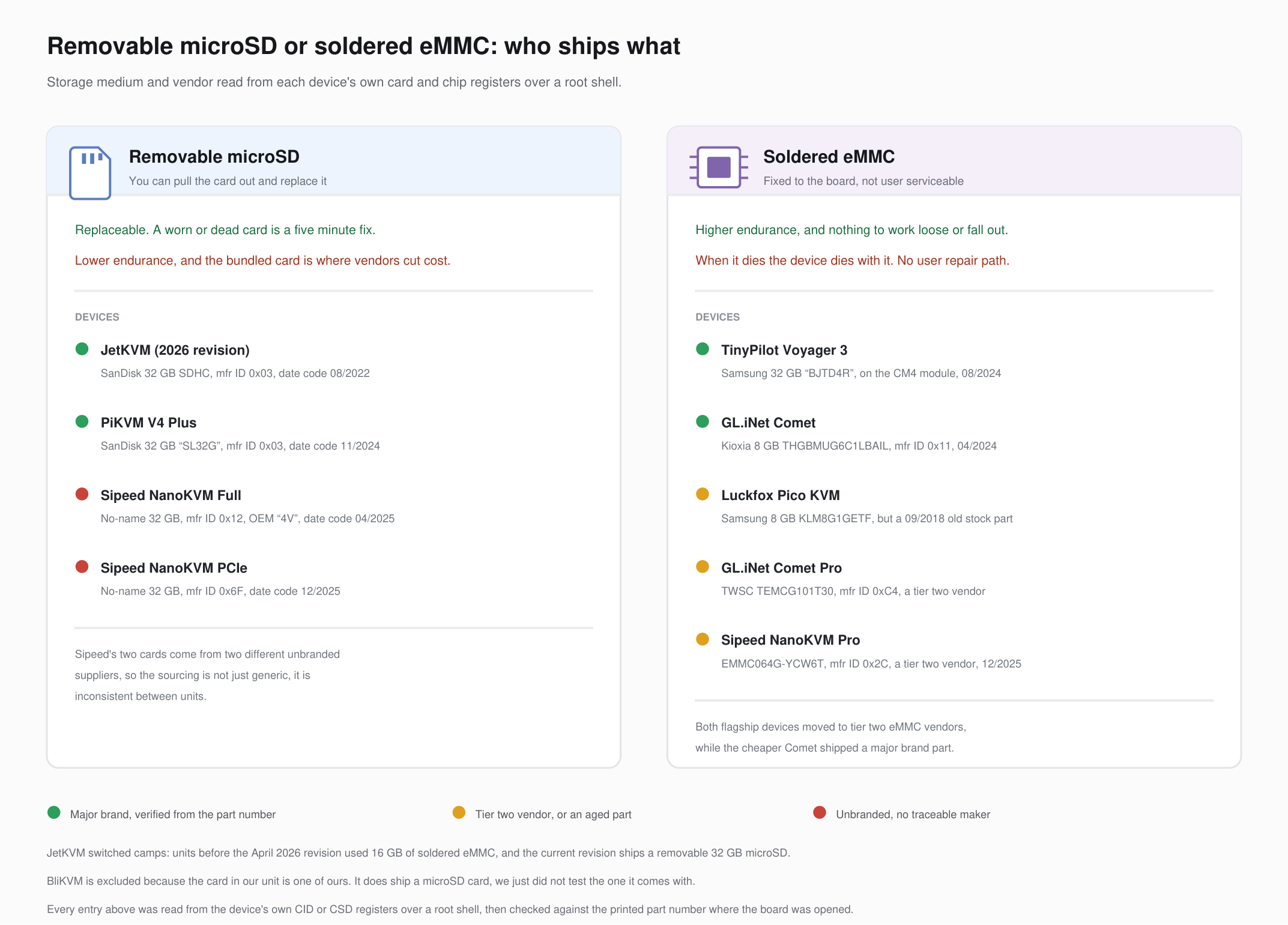
Four devices ship storage from a name you would recognize. The PiKVM V4 Plus boots from a genuine SanDisk SL32G microSD dated late 2024, sitting in the Raspberry Pi CM4's card slot. The JetKVM ships a SanDisk-based card under its own label, a common and legitimate rebadge. The base GL.iNet Comet carries a soldered Kioxia (formerly Toshiba) eMMC, and the TinyPilot Voyager 3 a soldered Samsung eMMC dated August 2024, both current, reputable parts.
This is what you want on a device you will not touch for years. SanDisk, Samsung, and Kioxia publish real endurance figures and are unlikely to be the reason your KVM dies.
The tier-2 and generic tier
The rest is a mixed bag. The GL.iNet Comet Pro uses a soldered eMMC from TWSC, a tier-2 Taiwanese vendor, and the Sipeed NanoKVM Pro a soldered eMMC that decodes to a tier-2 manufacturer as well. Neither is necessarily bad, but neither is a name you can look up an endurance rating for.
The two removable-card NanoKVMs are more concerning. The NanoKVM Full ships a generic DM-branded 32 GB microSD, and the NanoKVM PCIe a generic card under a Sipeed label. No-name microSD cards are exactly the parts most likely to be slow, mislabeled on capacity, or short-lived. If you buy a NanoKVM, the single cheapest reliability upgrade is to reflash a known-good card and put the bundled one in a drawer.
The oddest case is the Luckfox Pico KVM. It ships a genuine Samsung eMMC, which sounds good, until you read the date code: the chip was made in 2018. That is old stock, an eight-year-old part soldered into a 2026 product. Genuine, but not fresh, which is its own kind of corner-cutting. The Luckfox is a near-exact hardware clone of the JetKVM, and this is one of the few places the two differ, which we cover in the Luckfox Pico KVM review.
eMMC versus SD card: soldered reliability against replaceable risk
The storage type matters as much as the brand. Roughly half these devices boot from a removable microSD (PiKVM, JetKVM, both card-based NanoKVMs) and half from a soldered eMMC (the Comets, NanoKVM Pro, Luckfox, TinyPilot).
Each has a tradeoff. A removable SD card is the classic weak point of any Raspberry Pi-style device: cards wear out, and a worn card is the most common reason a Pi-based system stops booting. The upside is that when it dies, you swap in a new one and reflash. A soldered eMMC is generally more robust and better at wear-leveling, but if it fails, the device is a brick, because you cannot replace it without a hot-air station. So genuine soldered eMMC (the Comet, the TinyPilot) is the most set-and-forget option, a generic removable card (the NanoKVMs) is the easiest to fix but the most likely to need it, and a soldered generic eMMC is the worst of both. We go deeper on the endurance side in eMMC vs microSD in embedded devices.
Why this matters on a 24/7 device, and how it fits the bigger picture
An IP KVM's whole job is to be reachable when the machine it watches is down. It works at the hardware level, below the operating system, which is what separates it from software remote control like RDP or VNC: those need a booted, healthy OS, while an IP KVM gives you BIOS-level access and a working keyboard even when the machine is frozen at POST. It fills the same out-of-band role as a server's built-in BMC (Dell iDRAC, HPE iLO, or generic IPMI), as an external box for machines that lack one. If its own storage fails, all of that is gone at the exact moment you need it, so the flash is a genuine reliability variable, and one of the few places a maker can quietly cut cost because nobody checks.
It also connects to things buyers already weigh. On security considerations and vulnerabilities, the storage holds the firmware and keys, so a device with open-source firmware (PiKVM, JetKVM, the NanoKVMs) lets you reflash and audit what runs on that flash, which a closed appliance does not; the security scrutiny the NanoKVM drew in 2026 is a reminder that what sits on that storage matters. Firmware updates write to this same flash, so a chip that wears faster is a slow problem that compounds. On chipsets and hardware specifications, storage is one line in a bill of materials that also includes the SoC (Rockchip RV1106 and RV1126, the Raspberry Pi CM4's Broadcom BCM2711, the RISC-V CV181x, and Axera and Allwinner parts), the capture chip, and the RAM, all read in the same teardowns. On pricing, these devices span roughly $60 to $300, and storage is a corner cut at the low end, though price does not perfectly predict quality: the sub-$70 JetKVM ships a genuine SanDisk while the pricier NanoKVM Pro uses a tier-2 eMMC. Enterprise appliances from the likes of Raritan use industrial-grade storage for the same reliability reason, at many times the price. The 2026 security scrutiny of what sits on that flash was documented in detail by Tom's Hardware, our capture chip database does the same for the video path, and the Raspberry Pi CM4 documents the storage options on the two Pi-based units.
FAQ
No. The Sipeed NanoKVM Full and PCIe both ship generic, no-name microSD cards (one under a plain DM brand, one under a Sipeed label). On a 24/7 device, the cheapest reliability upgrade is to reflash a known-good card from a reputable brand and set the bundled one aside.
Soldered eMMC: GL.iNet Comet and Comet Pro, Sipeed NanoKVM Pro, Luckfox, and TinyPilot. Removable microSD: PiKVM V4 Plus, JetKVM, and the card-based NanoKVMs. Soldered eMMC is more robust but unrepairable if it fails; an SD card is replaceable but wears out sooner.
For reliability, genuine soldered eMMC is usually the more set-and-forget choice, because it wear-levels better and cannot be knocked loose. The catch is that if it dies you cannot replace it without soldering. A removable card is easier to fix but more likely to need it. The brand matters as much as the type.
Because the device runs continuously and its job is to be available when a machine is down. If its own flash fails, it is useless exactly when you need it. Storage is also one of the easiest places for a maker to quietly cut cost, since the part number is never published.
This report is built from our own teardowns; every part number was read off the board and confirmed against the storage device's registers, with capacities and date codes decoded from the part numbers. Disclosure: this guide is published by WarpKVM, which is developing an IP KVM of its own.